

FD Calculator
Find the maturity value and interest earned on your fixed deposit.
Bank FD • Post Office • Quarterly compoundingEstimate before TDS. Check your bank’s current FD rate before investing.
Fixed deposits are still one of the most trusted ways to save money in India. You know the rate when you open it, the money is safe from market ups and downs, and you know exactly when it matures. The one thing people often want to check is: how much will I get back?
This free FD calculator answers that. Enter the amount, rate and tenure, choose how often interest is compounded, and you get the maturity amount and total interest straight away.
How to use the FD calculator
- Enter the amount you want to deposit.
- Enter the yearly interest rate offered by your bank.
- Enter the tenure in years.
- Choose the compounding frequency. Most Indian banks compound quarterly.
- Tap Calculate to see the maturity value and the interest earned.
How FD maturity is calculated
A = P × (1 + r ÷ n)n × t
- A = maturity amount
- P = amount deposited
- r = yearly interest rate in decimal (7% = 0.07)
- n = number of times interest is compounded in a year (4 for quarterly)
- t = tenure in years
A worked example
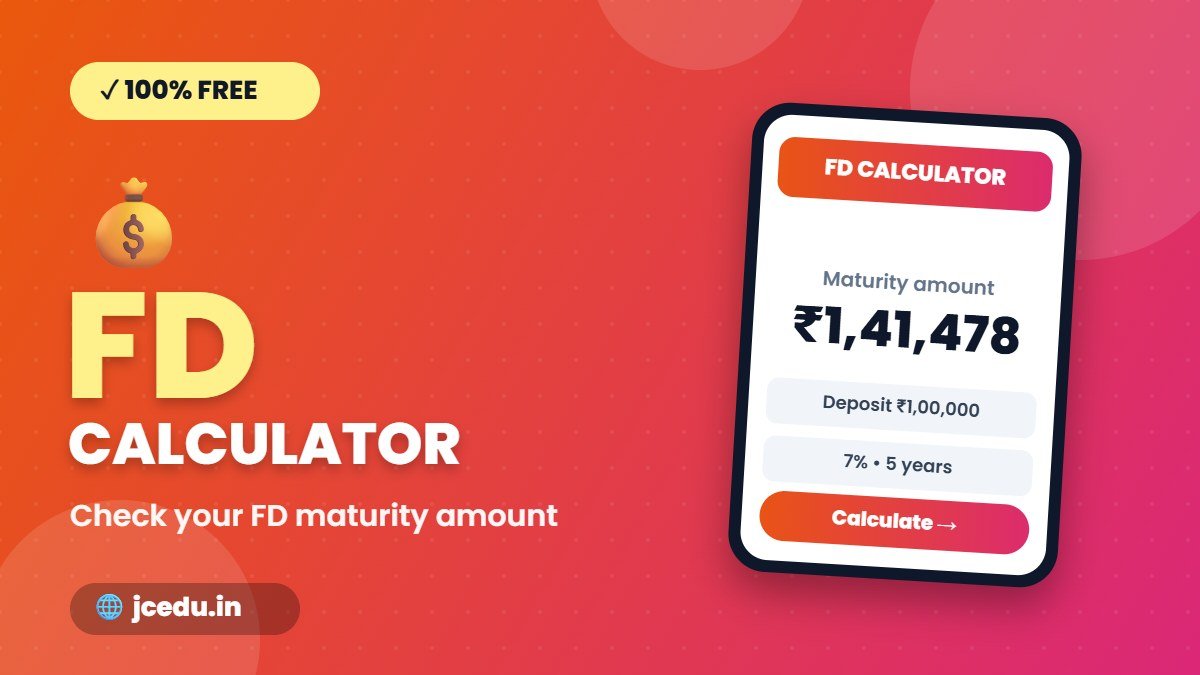
₹1,00,000 in an FD at 7% a year for 5 years, compounded quarterly, grows to about ₹1,41,478. The interest earned is about ₹41,478. With yearly compounding the same FD would give about ₹1,40,255, a little less, which shows why the compounding frequency matters.
Things to keep in mind
- FD interest is added to your income and taxed as per your slab.
- Banks deduct TDS when the interest crosses the yearly limit. Submit Form 15G or 15H if you are eligible.
- Senior citizens usually get a higher rate, often around 0.25–0.50% extra.
- Breaking an FD early can mean a lower rate and a small penalty, so pick a tenure you can stick with.
Frequently asked questions
Why is my bank amount slightly different?
Banks may count exact days or use simple interest for short FDs. Treat this result as a close estimate.
Is TDS included?
No. The result is before tax and TDS.
Which compounding option should I choose?
Choose quarterly unless your bank says otherwise. For monthly or quarterly payout FDs, the interest is paid out instead of compounding.
Is FD better than SIP?
An FD is safer and predictable; a SIP in equity funds may grow more over long periods but has market risk. Compare both with our SIP calculator.