

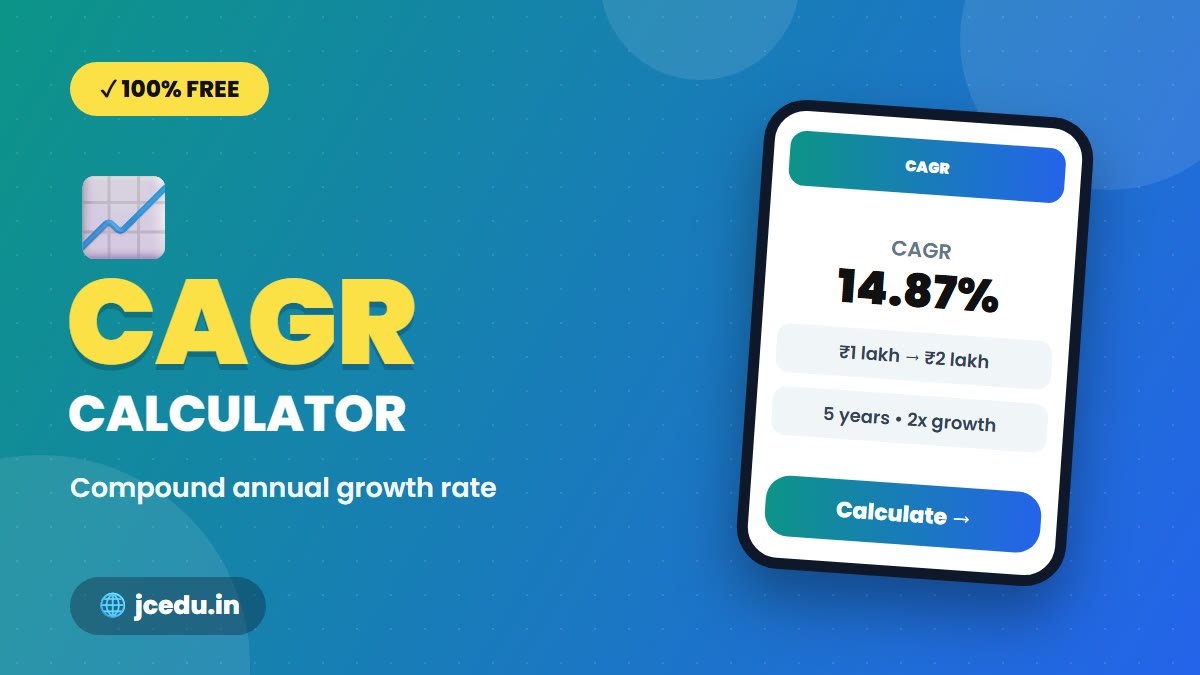
CAGR Calculator
Find the yearly growth rate of an investment, business sales or any value over time.
Investing • Commerce • BusinessCAGR shows a smooth yearly rate. Real returns usually go up and down from year to year.
CAGR (Compound Annual Growth Rate) tells you the average yearly growth of a value over several years, as if it grew at the same rate every year. This free CAGR calculator works for investments, mutual funds, stock prices, business sales and even population data.
How to use the CAGR calculator
- Enter the starting value.
- Enter the final value.
- Enter the number of years between them (half years such as 2.5 are allowed).
- Press Calculate CAGR.
CAGR formula
CAGR = (Final value ÷ Starting value)1/n − 1, where n is the number of years. Multiply by 100 to get a percentage.
Example: ₹1,00,000 grows to ₹2,00,000 in 5 years. (2,00,000 ÷ 1,00,000)1/5 − 1 = 20.2 − 1 ≈ 0.1487, so the CAGR is about 14.87% per year. The total return is 100%, but the yearly compounded rate is 14.87%, not 20%.
CAGR vs absolute return
- Absolute return is the total growth from start to end, ignoring time.
- CAGR spreads that growth over the years with compounding, so you can compare investments held for different periods.
- To see what a fixed rate grows to, use the Lumpsum Calculator or the Compound Interest Calculator.
Frequently asked questions
What is a good CAGR?
It depends on the asset. Compare with a fixed deposit rate and with inflation. A CAGR higher than inflation means your money grew in real terms.
Can CAGR be negative?
Yes. If the final value is lower than the starting value, the CAGR is negative, showing a yearly fall.
Is CAGR useful for SIP investments?
Not directly, because SIP money goes in at different times. For SIPs, XIRR is the correct measure. Use the SIP Calculator for estimates.
Is CAGR used in commerce exams?
Yes, CAGR and growth rates come up in Class 11–12 economics, commerce and business studies questions.