

Lumpsum Calculator
See how a one-time investment can grow at a yearly return rate.
Mutual funds • Investing • PlanningEstimate only. Mutual fund and stock returns are not fixed or guaranteed; past returns do not promise future returns.
A lumpsum investment means putting money in once, instead of every month. This free lumpsum calculator estimates what a one-time investment in a mutual fund or any other asset could grow to, based on an expected yearly return.
How to use the lumpsum calculator
- Enter the amount you want to invest once.
- Enter the return you expect per year (for example 7% for debt funds or 12% for equity funds over the long term).
- Enter the number of years you will stay invested.
- Press Calculate Returns.
Lumpsum formula
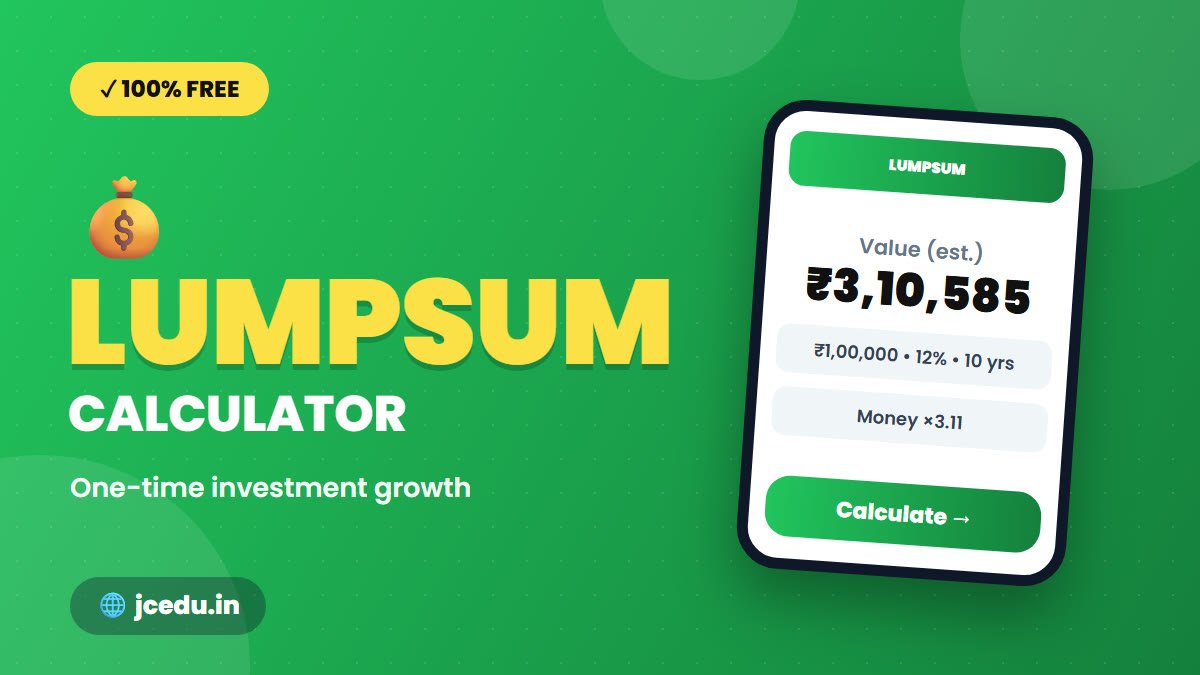
Future value = P × (1 + r ÷ 100)n, where P is the amount, r the yearly return and n the number of years. Example: ₹1,00,000 at 12% for 10 years = 1,00,000 × 1.1210 ≈ ₹3,10,585. Your money grows about 3.1 times.
Rule of 72
A quick way to guess how long money takes to double: divide 72 by the yearly return. At 12% money doubles in about 6 years, at 8% in about 9 years. The calculator gives the exact answer.
Lumpsum or SIP?
- Lumpsum suits money you already have, such as a bonus or maturity amount.
- SIP suits monthly savings from salary and spreads your buying over time. Compare with the SIP Calculator.
- For a guaranteed return, compare with a fixed deposit using the FD Calculator.
Frequently asked questions
Are lumpsum returns guaranteed?
No. Mutual fund returns depend on the market and can go up or down. Use the calculator to see possible outcomes at different return rates.
What return rate should I use?
Use a conservative number. Try a few rates, for example 8%, 10% and 12%, to see a range instead of one number.
Does the calculator include tax?
No. Capital gains tax and fund expenses are not included, so the real amount you receive can be a little lower.
Is this investment advice?
No. It is an educational calculator. Talk to a registered adviser before investing.